
Week two: starting the job (days 8 to 14)
Oct 06, 2026
Your second week in the US is when the job starts. It's also when most of the paperwork that decides your first year lands on your desk.
Some of it is routine. Some of it, if you get it wrong, won't show up until next April, when it's far more expensive to fix. Here's what to expect and where to be careful.
Day one at work: two forms from HR
On your first day, HR will hand you two forms. They look similar. They're not.
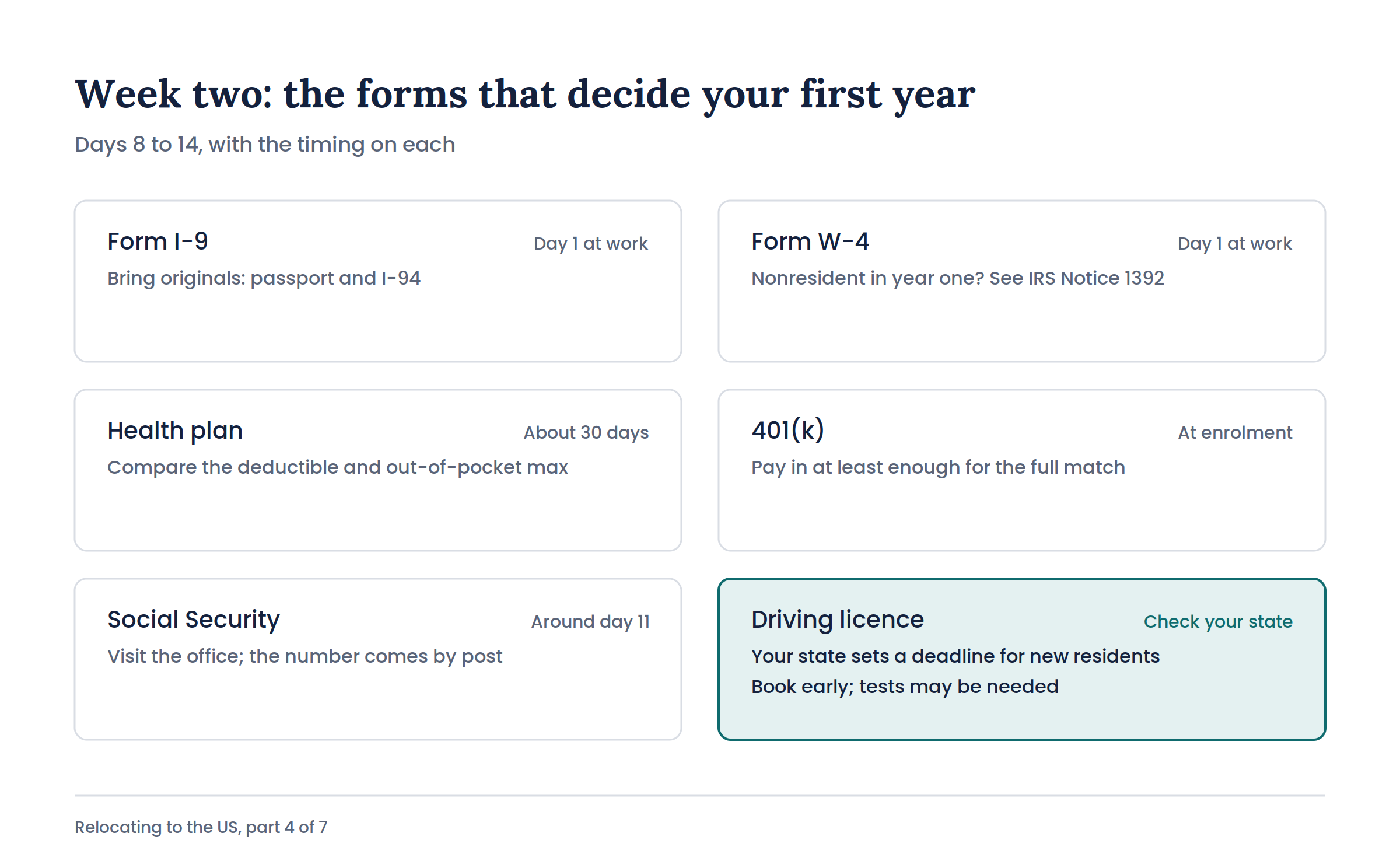
Form I-9 is the right-to-work check. Every US employer has to carry it out for every employee, US citizens included, so don't take it personally. You fill in your part on day one, and your employer then has three business days to check your original documents. For most people coming on a work visa, that means your passport and your I-94. Bring the originals, because photocopies won't do.
Form W-4 tells payroll how much federal tax to take from each pay packet. Think of it a bit like choosing your own tax code. This is the one to be careful with.
Many visa holders count as nonresidents for tax purposes in their first year. Nonresidents have to complete the W-4 differently from everyone else, and the standard instructions won't tell you that. The IRS explains the rules in Notice 1392. Read it, or ask someone who knows. Get it wrong and you'll find out in April.
Choosing your health plan
You'll usually have around 30 days to choose your health plan. It's tempting to pick the one with the lowest monthly premium. Don't stop there.
Look at the deductible, which is what you pay before the insurance starts paying. Then look at the out-of-pocket maximum, the most you'd pay in a year if things go badly. A cheap premium can hide a very expensive year if someone in the family needs treatment.
Sign up for the 401(k), at least up to the match
At the very least, pay enough into your 401(k) to get the full employer match. If you don't contribute enough to claim it, you're effectively turning down part of your pay.
Around day 11: the Social Security office
This is when you go to the appointment you booked in week one. On most work visas, day 11 or so is when the Social Security Administration's records catch up with your arrival.
Your number will arrive by post. Keep an eye out for it, because the driving licence office will ask for it.
The deadline people forget: your driving licence
Once you start work, most states treat you as a resident. Residents get only a limited time to swap to a local driving licence. In Florida, for example, it's 30 days. Check your own state's motor vehicle department for the exact deadline.
Book the appointment this week. Offices get busy, and slots go quickly. Depending on your state and where your current licence was issued, you may also need to sit a written test and a road test, so build that time in.
And keep house-hunting
Meanwhile, keep looking for somewhere to live. If you have children, the lease you sign next week is what gets them into school. Don't let this slip while you settle into the office.
The takeaway
Week two is busy, but it's mostly about getting a handful of forms right first time. Take the W-4 seriously, look past the headline premium on your health plan, claim the full 401(k) match, and get that licence appointment in the diary.
Next in the series: days 15 to 21, signing the lease and everything that follows from it.
