
Week four: the licence, your first payslip, and settling in (days 22 to 30)
Oct 06, 2026
If there's one form to be really careful with in your first month, it's the driving licence application. That's not because it's complicated. It's because of one question on it that has nothing to do with driving.
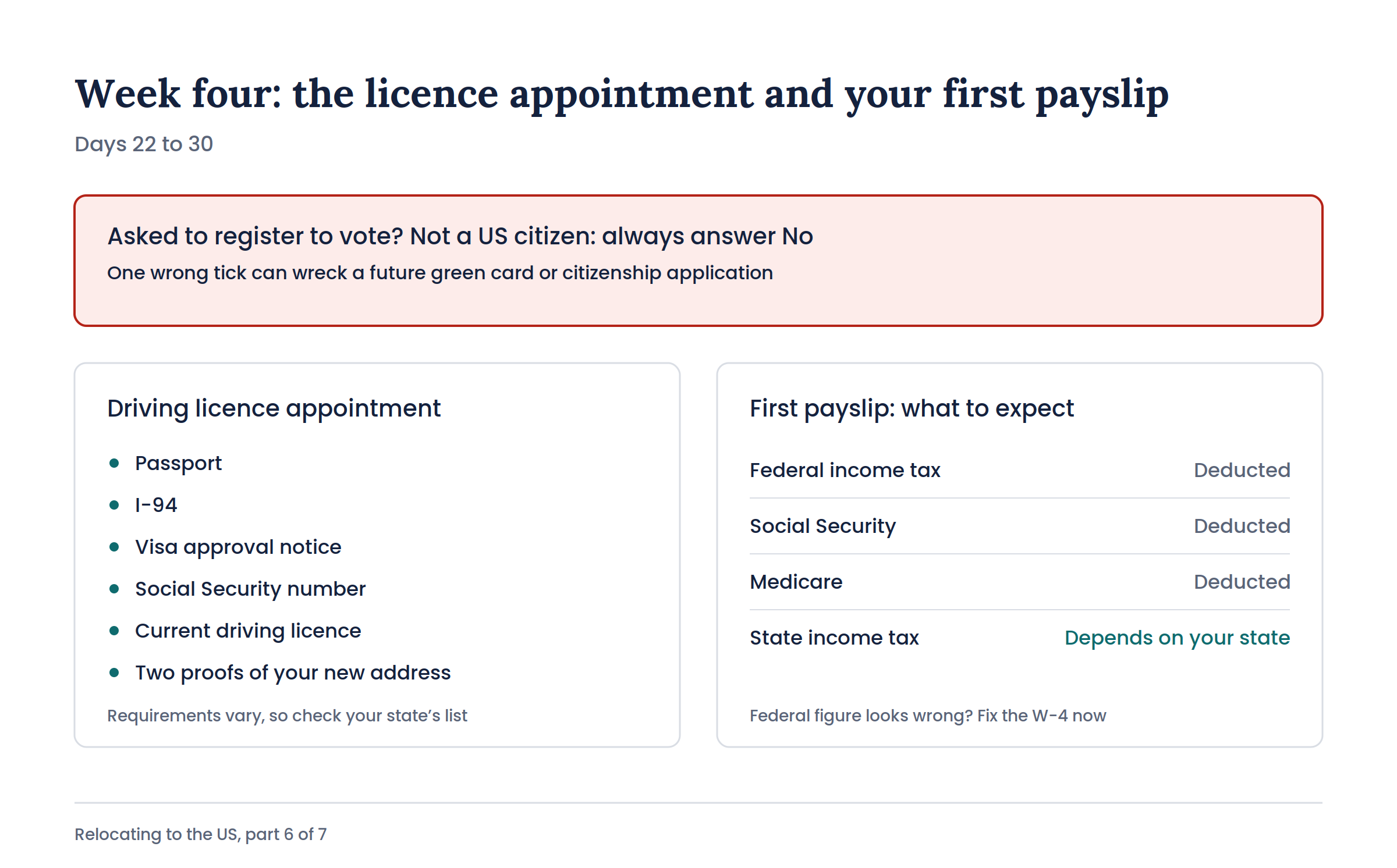
Read every screen: the voter registration question
Driving licence offices across the US also handle voter registration, and the application will usually ask whether you want to register to vote.
If you're not a US citizen, the answer is no. Always.
A non-citizen who registers to vote commits a serious offence, even if they only ticked the wrong box by accident. It can wreck a green card or citizenship application years later. So slow down, and read every screen before you click.
What to bring to the licence appointment
Requirements vary by state, so check your state's list. You'll typically need:
- Your passport
- Your I-94
- Your visa approval notice
- Your Social Security number
- Your current driving licence
- Two proofs of your new address (the lease and utility bill from last week will usually do)
And read your state's driver handbook the night before. US traffic law is set state by state, and some rules will be new to you, such as turning right on a red light or stopping for school buses.
Check your first payslip properly
Your first full payslip should have arrived by now. Don't just glance at the bottom line. Check it properly.
You should see federal income tax taken off. You'll also see Social Security and Medicare deductions, which apply to almost everyone whatever your W-4 says. Whether there's also a state income tax line depends on where you live. Some states, including Florida and Texas, don't have one.
If the federal tax figure looks wrong, fix your W-4 now. It's a five-minute job today and a much bigger headache in April.
Check in on school credits
By now the children should be in school. If you have high schoolers, book a conversation with the school counsellor and ask exactly how their UK work has been credited. It affects their graduation requirements and their GPA, and it's much easier to sort out early in the year than at the end.
Chase what's still outstanding
A few things will still be in the post or on the water. Chase them:
- Your Social Security card
- Your green card, if you're on that route
- Your sea freight
While you're at it, put your visa and I-94 expiry dates in the diary with plenty of warning, not just on the day. And tell HMRC you've left the UK.
Last of all: join something
Join the local RICS or AACE group. Or a sports club, or the parents' association at school. Anything that puts you in a room with people who live here.
The paperwork will get done anyway. What takes longer is feeling like you actually live here, and that's the part that makes a move work.
Next in the series: months 2 to 12, and the tax form most UK professionals have never heard of.
