
The rest of year one: FBARs, tax returns and the rules that don't go away (months 2 to 12)
Oct 06, 2026
You've survived the first month. The paperwork has calmed down, the children are in school and the commute is starting to feel normal.
But the most expensive mistake UK professionals make in their first year in the US usually happens the following spring, on a form most of them have never heard of.
The FBAR: the form nobody tells you about
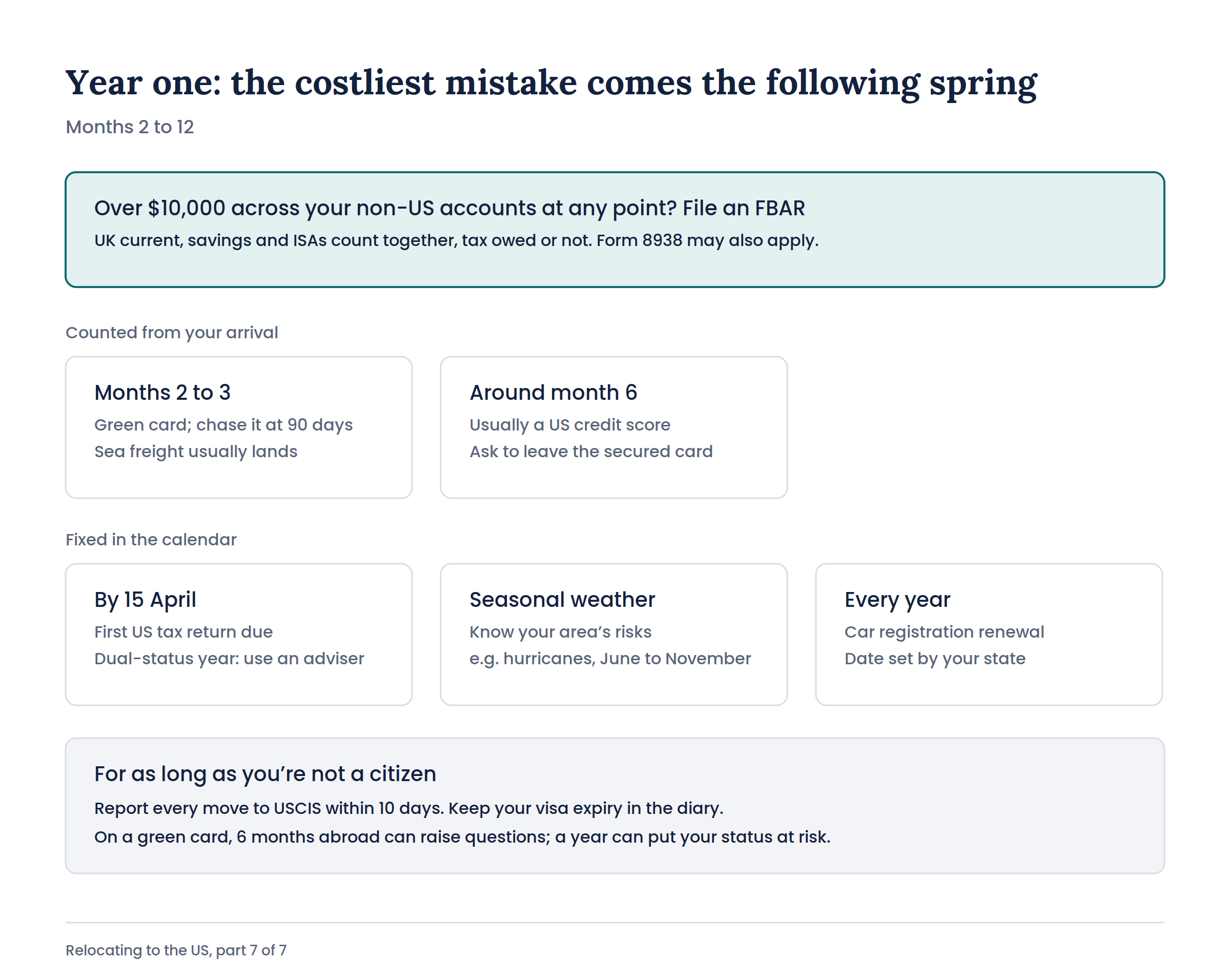
If your bank accounts outside the US add up to more than $10,000 at any point in the year, you have to report them to the US Treasury. The form is called an FBAR.
A few things to understand about it:
- It counts everything together. UK current accounts, savings accounts and ISAs are all added up. You don't need $10,000 in any one account.
- It doesn't matter whether any tax is owed. The FBAR is a reporting requirement, not a tax bill.
- The penalties for not filing are heavy. This isn't one to leave until you get round to it.
A second form, Form 8938, may apply as well.
Here's the catch. We'd advise most people to keep a UK account open, and most people who do will cross that $10,000 threshold at some point. So assume this applies to you until an adviser tells you otherwise.
Your first US tax return
Your first US tax return is due by 15 April.
The year you arrive is usually a "dual-status" year. For part of it you're treated as a resident for tax, and for part as a nonresident. It rarely fits neatly into standard tax software.
Pay for an adviser who handles both UK and US returns. While you're there, ask them about your ISAs and any UK funds. The US doesn't treat an ISA as tax-free, and some UK funds are taxed harshly. If you didn't deal with this before you left, now is the time.
What else happens across the year
Months two and three. If you're on the green card route, your card should arrive around now. USCIS says to contact them if it hasn't come within 90 days. Your sea freight usually lands around this point too.
Around month six. After about six months of on-time card payments, you'll usually have a US credit score. Ask your bank to move you off the secured card and onto a standard one.
Seasonal weather. Find out what your area is prone to and plan before the season starts. On the Gulf and East Coasts, for example, hurricane season runs from June to November. Have a plan in place before June, not in the week a storm is forecast.
Car registration. Check when your state's renewal falls and put it in the diary. In Florida, for example, it renews every year on your birthday, which catches people out.
The rules that apply for as long as you're not a citizen
Some obligations don't end after year one:
- Report every move to USCIS within 10 days. Every time, for as long as you're not a citizen.
- Diary your visa expiry well in advance.
- On a green card, be careful with long trips abroad. Six months away can raise questions about whether you still live in the US, and a year can put your status at risk. Think about that before you plan an extended stay back in the UK.
The takeaway
None of this is difficult. It just isn't obvious when you arrive, and in the US system, not knowing is rarely accepted as an excuse.
Get the right adviser and put the key dates in the diary. Then your first year can be about the job, the family and the new life you came for, rather than the paperwork.
That's the end of our Relocating to the US series. If you're a UK surveyor weighing up a move, we'd be glad to talk it through.
