
Before you sign: what to agree with your US employer
Oct 06, 2026
Most UK surveyors we talk to about a move to the US ask about salary first. Fair enough. It's the number on the offer letter, and it's usually a big one. But a lot of what makes a US package good or bad never appears on the salary line at all.
Here's why that matters. In the UK, the law does a lot of the negotiating for you. You get 28 days' paid holiday, statutory sick pay and an employer pension contribution whether you ask for them or not.
In the US, very little of that is guaranteed. There is no legal minimum for paid holiday. There's no federal requirement for paid sick leave, and many states don't require it either. Your pension depends entirely on what your employer chooses to put into your 401(k). The simplest rule we can give you is this: if it isn't in the contract, assume you don't have it.
So before you hand in your notice, get the following in writing.
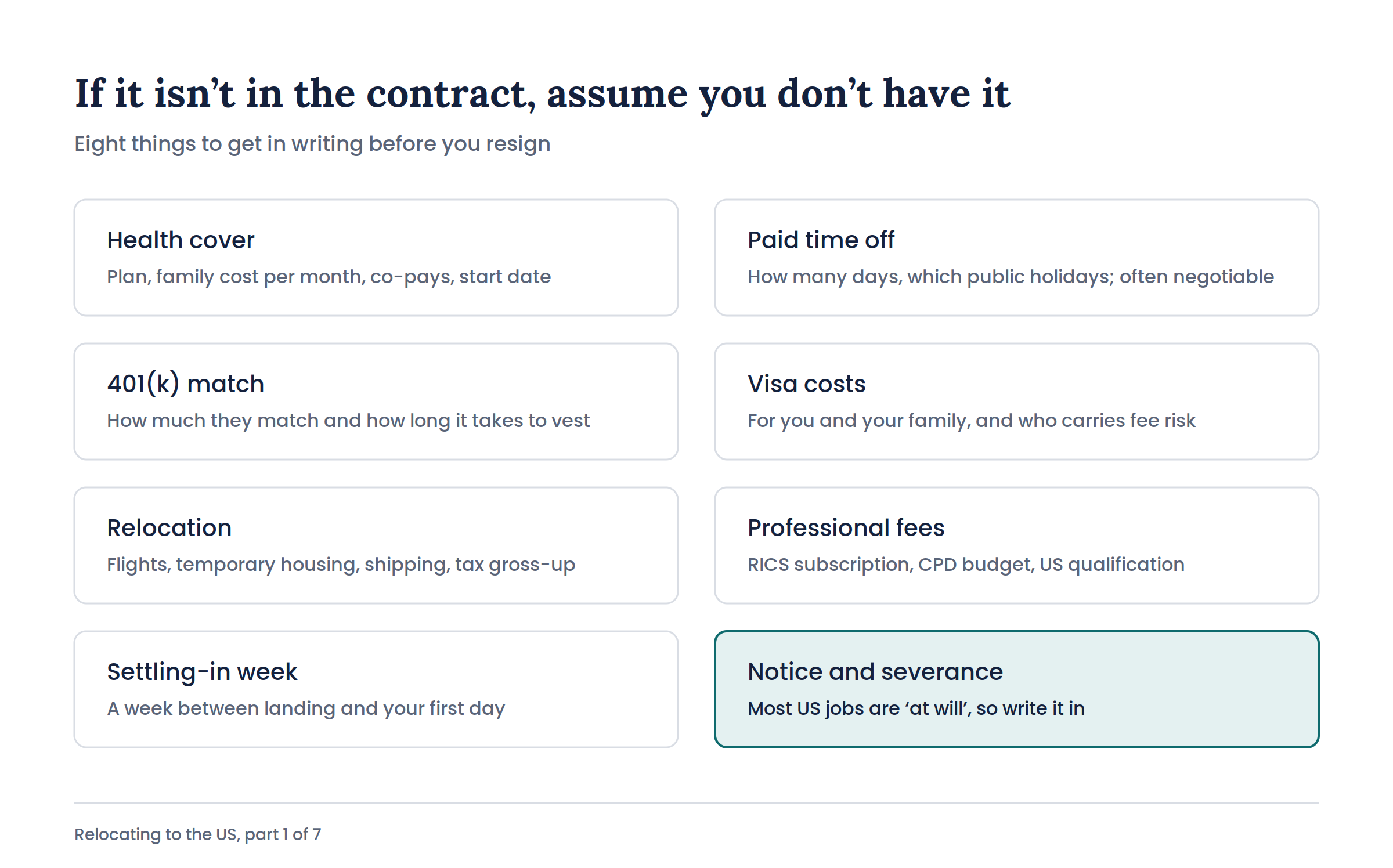
1. Health cover
This is the big one, and it's the one UK candidates most often underestimate. Ask which plan you'll be on, what you'll pay each month for family cover, and what the co-pays look like when you actually use it.
Then ask the question nobody thinks to ask: when does it start? Many US plans only begin on the first of the month after you join. Start on the 3rd and you could be uninsured for almost four weeks. If so, you'll need your own cover for the gap. With children, that's not a gap you want to leave open.
2. Paid time off and public holidays
Ask exactly how many days of paid time off you'll get and which public holidays the company observes. US allowances are often a shock compared with what you're used to.
The good news is that it's frequently negotiable, especially if you're senior. If you're coming over as an associate director or above, push. It's far easier to agree now than to raise it once you've started.
3. The 401(k) match and the vesting schedule
The 401(k) is the closest thing to a UK workplace pension. Find out how much the employer matches. Then ask how long it takes for that money to vest, which means to become genuinely yours. Some employers' contributions vest immediately; others vest over several years. If you might move on within a few years, that difference matters.
4. Visa costs for you and your family
Agree up front who pays for your visa, and for your spouse's and children's. This is especially important right now, because H-1B fees are a moving target. The $100,000 fee on new petitions for workers outside the US has been extended to September 2027, although a court has stopped USCIS collecting it for now (Mintz, 23 September 2026). Make sure your offer is clear about who carries that risk if the position changes.
5. Relocation support
Get the detail, not just the headline figure. Ask about:
- Flights for you and your family
- How many weeks of temporary housing are included
- Shipping your belongings
- Whether they'll gross up the tax on the relocation package. Relocation payments are often taxable, and without a gross-up you could be left paying the bill yourself.
6. Professional fees and development
Will they pay your RICS subscription, or your membership of any other professional body? Is there a CPD budget? And if you'll want a US qualification down the line, will they support you towards it? These costs add up over a career, and they're easy to agree at offer stage.
7. A settling-in week
Ask for a week between landing and your first day at work. With children, you will need it. There's a bank account to open, a phone to sort, and schools and homes to look at. That first week will go very quickly.
8. Notice and severance: the one that catches people out
Almost every US job is "at will". That means either side can end the employment at any time, without notice and without a reason. There's no statutory notice period like you'd have in the UK.
If a notice period or a severance payment matters to you, it has to be written into your contract. If you're uprooting your family across the Atlantic, it probably should matter. Don't rely on goodwill or what's "normal" at the firm.
The takeaway
A US offer can be genuinely excellent. But you can only judge it once you can see the whole package: health, holiday, pension, visa, relocation, professional support and protection if things don't work out. Get it all in writing before you resign, and you'll go into the move with your eyes open.
Next in the series: the three months before you fly, and the expensive mistakes that happen when things are left too late.
